
The Gnarliest SQL Mistake I See Marketers Make
KPIS
The CMO sits across from Sales leadership. Again.
"Why aren't these SQLs converting?"
It's the third time this month. Same question. No wrapper this time.
Marketing hands over 400 SQLs. Sales accepts 18. Of those, 3 become opportunities.
Everyone blames definition drift. Nobody asks the right question.
The problem isn't the definition
SQL isn't broken because the criteria are wrong.
SQL is broken because it was never designed to do the job you're asking it to do.
Most teams treat SQL as a quality gate.
A threshold.
A score that says "this lead is good enough."
But SQL doesn't measure quality. SQL measures resource allocation.
The moment you forget this, the entire system collapses into noise.
What SQL actually does
SQL answers one question: "Is this lead worth real sales time?"
Not "Is this lead qualified?"
Not "Does this lead match our ICP?"
Not "Did this lead hit 80 points?"
The real question is scarcer and harder:
"Given the finite hours my sales team has this week, should this lead get one of those hours?"
Everything else is theatrical.
When marketing defines SQL as "engaged with three pieces of content and visited pricing twice," they're measuring marketing activity.
When sales define SQL as "expressed clear pain and has budget," they're describing their ideal conversation.
Neither definition connects to the constraint that actually matters. Sales capacity.
The capacity equation nobody runs
Imagine a sales team has 30 hours per week to evaluate new leads. Not total work hours. Not meeting time. Just the hours available for "should I pursue this?" decisions.
Each lead takes 15 minutes to evaluate. Read the form. Check LinkedIn. Send first touch. Log outcome.
Simple math: 30 hours divided by 5 days divided by 0.25 hours per lead equals 24 slots per day.
That's your SQL ceiling.
Not 400 per month. Not "whatever marketing can generate." Not "as many as possible."
Twenty-four per day on a good day.
If marketing hands over 50 SQLs today, 26 of them will decay before anyone touches them. Intent signals fade. Context disappears. The lead becomes cold by structural inevitability, not sales laziness.
But nobody tracks slots. Nobody measures discovery time. Nobody connects SQL volume to the physical constraint of human attention.
So the system optimizes for the wrong variable. Marketing chases SQL volume. Sales complains about SQL quality. Both are solving fictional problems.
The real problem is that you're trying to pour 50 leads into 24 slots.
Let's make this concrete.
Your company has three SDRs. You ask each one:
"How many hours per week do you actually spend evaluating new leads? Not following up on existing conversations, not doing admin work, not in team meetings, but making first decisions on fresh leads?"
SDR 1 says 8 hours.
SDR 2 says 12.
SDR 3 says 10.
Total capacity: 30 hours per week.
Now you pull ten recent leads and ask the same SDRs: "How long did each take before you knew yes or no?" They check their notes.
Average: 15 minutes per lead. Some took 5 minutes because the fit was obviously wrong. Some took 25 minutes because the company looked promising, but the role was unclear, and they had to dig.
Fifteen minutes average equals 0.25 hours per lead.
The math: 30 hours of capacity divided by 5 workdays equals 6 hours per day. 6 hours divided by 0.25 hours per lead equals 24 slots per day.
This is not theoretical. This is simple math.
Your marketing team generated 280 SQLs last month. That's roughly 14 per workday. Well within capacity, right?
Wrong.
Because those 280 SQLs didn't arrive at 14 per day. They spiked.
Webinar on Tuesday delivered 45 SQLs.
Email campaign on Thursday delivered 38.
Friday's demo signups added 22.
On those days, you had 24 slots but received 45, 38, and 22 leads. The overflow sat unworked.
By Monday, those leads were four to six days old. The SDRs reached out anyway because the leads were "qualified."
But the context was gone. Most buyers have moved on or cooled down.
Conversion rate for leads contacted within 24 hours: 18%.
Conversion rate for leads contacted after four days: 5%.
Same ICP. Same intent signals. Different timing.
The capacity constraint isn't just about total volume. It's about volatility. If you can't smooth the flow, you can't protect the slots.
Why MQL makes this worse
Marketing Qualified Leads (MQL) measure marketing's ability to generate activity. Downloads. Webinar attendance. Email opens.
These signals tell you someone is paying attention. They don't tell you someone is ready to buy.
MQL was invented to give marketing a success metric independent of sales outcomes. Defensible. Controllable. Owned.
But it created a buffer between marketing activity and buyer reality.
MQL becomes a puff layer.
Marketing reports "1,200 MQLs generated."
Sales receives 400 SQLs.
A few get accepted.
Of those, 3 become opportunities.
The conversion decay happens in silence.
Nobody asks: "What if the 1,200 MQLs were never real leads at all?"
Because MQL measures engagement, not intent. And engagement is easy to manufacture. Intent is not.
The Buyer Flywheel is designed to collapse this buffer with Buyer Signals:
real fit,
real intent,
real behavioral cues
Replace engagement theater.
You stop measuring "did they download?" and start measuring "are they evaluating?"
The signal sharpens. The noise drops.
The ranking problem you're not solving
Most SQL definitions are binary. Yes or no. Qualified or not.
This forces a fiction: that all SQLs are equally valuable.
They aren't.
A lead who visited pricing three times, requested a demo, and matches your ICP exactly is not the same as a lead who downloaded an ebook and works at a company in your target industry.
But if both meet your SQL criteria, both get treated identically.
Binary definitions create artificial equality. They flatten signal strength into a single gate. And when capacity is constrained, this flattening destroys your ability to prioritize.
The fix is ranking.
Fit plus intent equals rank.
Fit is binary: right company size, right role, right use case.
Intent is countable: pricing page views, demo requests, product evaluation behavior, problem-specific questions.
High fit, high intent? Top of the list. High fit, low intent? Middle tier. Low fit, high intent? Investigate or nurture.
Then sales receives the top N ranked leads that fit within their daily slots.
Here's what this looks like in practice.
Monday morning, marketing's system generates a ranked list of 47 leads based on Friday's activity.
Lead 1: VP of Operations at 200-person company in target industry. Visited pricing page three times. Requested demo. Watched product walkthrough video. Rank score: 9.
Lead 2: Director of Marketing at 150-person company in adjacent industry. Visited pricing twice. Filled out "Contact Sales" form. Rank score: 7.
Lead 3: Manager at 50-person company in target industry. Downloaded case study. Visited homepage. Rank score: 3.
Your daily slot capacity is 24 leads.
Sales receives leads 1 through 24 from the ranked list. Lead 3 doesn't make the cut today because 21 other leads have stronger signals.
Lead 3 doesn't disappear. It stays in the system. If intent strengthens—another pricing page view, a product-specific question via chat—the rank increases and it moves up. If intent decays—no further activity for 48 hours—it drops into nurture.
This is Sales Resource Allocation. Not a score threshold. A ranked list constrained by capacity.
It aligns marketing's incentive to generate volume with sales' need for quality.
Because quality is now defined by rank position, not by clearing a bar.
The moment you switch from binary to ranked, you stop arguing about whether a lead is "qualified."
You start asking: "Is this lead more valuable than the other 46 we're evaluating today?"
That question has a mechanical answer.
Time decay exposes the second lie
Intent fades.
A pricing page view from two weeks ago predicts nothing. A demo request from yesterday predicts a lot.
But most SQL systems ignore time. A lead enters the SQL pool and sits there until sales decides to act. Days pass. Intent signals weaken. Context disappears.
By the time sales reaches out, the lead doesn't remember why they engaged in the first place.
Time decay fixes this by making SQL ephemeral.
Rule: if sales doesn't make first contact within 24 hours, the lead gets downgraded and re-ranked.
This does two things.
It forces speed. Buyer intent has a half-life. Respect it or lose it.
It prevents gaming. Marketing can't pad SQL numbers with stale leads. Sales can't sit on leads and blame quality later.
Time decay makes SQL a live system. It stops being a static label and becomes a dynamic allocation tied to real-time buyer behavior.
Consider what happens without time decay.
A lead requests a demo on Monday. The SDR is slammed with existing conversations and doesn't reach out until Thursday. By Thursday, the lead has talked to two competitors, gotten pricing from one, and scheduled a demo with another.
When your SDR finally calls, the lead says: "Oh yeah, I filled that out. We're actually in late-stage conversations with [competitor] now. Thanks anyway."
The SDR logs it as "timing issue" or "competitor locked in." But the real issue was structural.
The lead was ready Monday. The system didn't respect the signal's decay rate.
Now add time decay.
Monday's demo request enters the system with rank score 9.
Tuesday morning, no contact has been made.
The system automatically downgrades the lead to rank score 6 and pushes it lower in the queue.
By Wednesday, if still untouched, it drops to rank score 3 and moves into automated nurture.
This creates pressure on the system to act fast or lose the lead. It also creates honesty. If your team genuinely can't reach out within 24 hours, you don't have capacity for that many SQLs. The system should reflect that reality, not hide it.
The Buyer Flywheel governs this with Calibration Protocols.
Systematic process to adjust strategy as per feedback.
Like handoff rules - which must be explicit.
Follow-up must be fast.
Drift happens when workflows assume buyers will wait. They won't.
The cost nobody calculates
Every bad SQL costs real money.
Track it: number of rejected SQLs multiplied by average discovery time multiplied by cost per sales hour.
Example: 100 rejected SQLs per month. Each takes 15 minutes to evaluate. Sales costs $100 per hour.
100 leads × 0.25 hours × $100 = $2,500 per month in wasted sales time.
Thirty thousand dollars per year spent evaluating leads that were never real.
But nobody quantifies this.
Sales complains.
Marketing defends.
Leadership asks for better alignment.
The cost remains invisible.
Once you make it visible, the conversation changes. Because now the SQL problem isn't a feelings problem. It's a resource leak with a dollar amount attached.
And resource leaks get fixed.
The feedback loop that doesn't exist
SQL quality can't improve without structured feedback from sales.
Most teams have informal feedback. Sales mentions "this lead was bad" in Slack. Marketing asks "why?" Sales says "not a fit."
That's not feedback.
Real feedback requires taxonomy. Five to seven rejection categories:
Bad fit (wrong company size, wrong role)
No intent (not actually evaluating)
Timing issue (interested but not ready)
Budget mismatch
Competitor locked in
Sales logs every rejected SQL into one of these buckets. Weekly, marketing and sales review the distribution.
If 60% of rejections are "bad fit," the ICP definition is wrong.
If 40% are "no intent," the intent signals are weak.
If 30% are "timing issue," the nurture strategy needs work.
Here's what the weekly review actually looks like.
Every Monday at 10am, marketing and sales meet for 15 minutes. Not a strategy session. Not a blame session. A data review.
Marketing pulls last week's top 24 ranked leads - ones that actually got handed to sales within the daily slot limit.
The team goes through them:
Lead A: became opportunity. No discussion needed.
Lead B: rejected—bad fit. Why? Company size was right, but role was wrong. The form said "Director of Operations" but LinkedIn showed they were actually a junior analyst with an inflated title. The ICP filter missed it.
Action: add LinkedIn verification step before ranking.
Lead C: rejected—no intent. Why? The lead visited pricing but immediately bounced. The trigger fired on a single pageview with eight seconds of engagement. Not real evaluation behavior.
Action: change intent rule from "one pricing view" to "two pricing views with 30+ seconds each."
Lead D: rejected—timing issue. Why? Lead said "we're interested but not until Q2 next year." This is a nurture case, not an SQL.
Action: add question to demo request form asking "when are you looking to implement?" Leads who say "6+ months" skip SQL and enter long-term nurture.
By the end of 15 minutes, marketing has three concrete adjustments to make. Next week, the same leads don't get rejected for the same reasons.
This is Feedback Corrections. The Buyer Flywheel learns from each SQL. Rejection reasons become input signals. Next week's SQL definition improves based on last week's outcomes.
Without this loop, SQL becomes a static contract. With it, SQL becomes a learning system.
Most teams skip this step because it feels bureaucratic. But the alternative is guessing. And guessing compounds error.
Why your experiments keep failing
Teams run SQL experiments constantly.
New scoring models.
New qualification criteria.
New handoff processes.
Most fail.
Because the experiments aren't connected to a hypothesis about system behavior.
"Let's try scoring engagement differently" is not a hypothesis.
"SQLs with three pricing page views convert 20% better than SQLs with one" is a hypothesis.
The first is a wish. The second is testable.
Real SQL experiments isolate one variable, measure one outcome, run for a fixed duration.
Experiment: Top N ranked leads produce higher conversion than current SQL volume approach.
Metric: SQL to opportunity conversion rate.
Duration: Six weeks.
Success: Conversion improves by 15% or more, and first-touch contact happens within 24 hours.
This is how you validate the system. By testing structural changes against real outcomes.
What this means for the CMO
If you are a CMO, I best your problem isn't sales alignment.
It's that marketing built a system optimized for volume in a world constrained by capacity.
Marketing measures activity.
Sales measures outcomes.
The gap between them is structural, not personal. (Though it might seem to be outside-in)
Fixing SQL requires admitting that the current definition serves marketing's reporting needs, not sales' operational reality.
This is uncomfortable.
Because it means the SQL volume you've been reporting was never the right metric.
It means the MQL funnel you built might be fiction.
It means the content strategy designed to drive engagement might be optimized for the wrong signal.
But discomfort is the entry point to clarity. Once you admit SQL is resource allocation, the system simplifies.
You stop chasing volume. You start protecting slots.
You stop defending engagement metrics. You start tracking intent strength.
You stop treating all SQLs equally. You start ranking by fit and intent.
And you stop getting asked "why aren't these SQLs converting?"
The one change that matters
If you do nothing else, do this:
Calculate your daily SQL slots.
Sales capacity divided by discovery time divided by workdays.
Then limit SQL handoffs to that number.
Marketing generates a ranked list. Sales receives the top N leads that fit today's capacity. Everything else waits or gets nurtured.
This single change forces the entire system to realign.
Marketing can't chase volume because volume beyond capacity is waste.
Sales can't complain about quality because every handoff is intentional and ranked.
Leadership can't ignore the constraint because the constraint is now visible and measurable.
And SQL stops being a negotiation. It becomes a mechanical process tied to real buyer signals and real sales capacity.
That's a different system. A better one in my opinion.
Next move:
Enforce the limit for 30 days.
Track SQL to opportunity conversion.
Measure time to first contact.
Log rejection reasons.
If conversion improves, you've proven the system works. If it doesn't, you've learned where the real problem lives. Either way, you stop guessing.
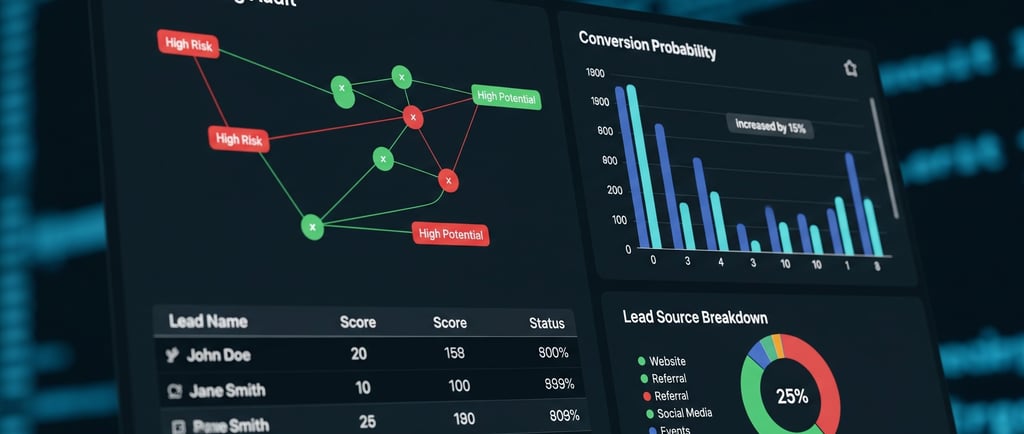
Get the Lead Score Audit below at no cost.