
What are Buyer Signals?
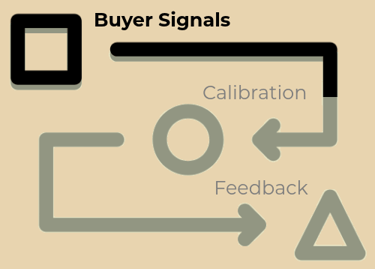
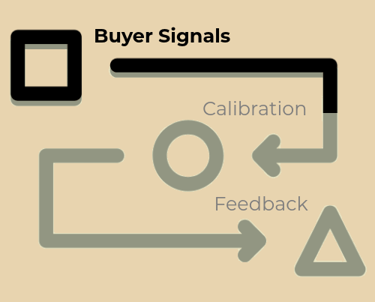
Signals show what moves buyers and what buyers do. Systems drift because they misread both.
Passive Source 1: Web Behavior
The Digital Layer describes the non-linear path they take to your product.
Tech: Website Analytics (GA4) | Deanonymization (Clearbit/6sense) | Session Recording (Hotjar/PostHog).
What to Extract:
Pricing Velocity: Did they visit Pricing before Product? (Budget Intent).
Technical Deep Dives: Did they spend 5+ minutes on the API docs? (Implementation Intent).
The Loop: Did they return to the same case study 3 times? (Internal Selling).
The Output: Trigger specific outreach. Send content based on what they read, not just who they are.
Passive tell you what happened.
Active tell you why it happened.
Insight only appears when they align. Anecdotes don’t count.
Passive Source 2: Call Recordings
The Voice Layer describes raw audio from sales calls.
Tech: Conversation Intelligence (Gong/Chorus/Zoom).
What to Extract:
Syntax: The specific words buyers use to describe pain. (e.g., Do they say "Slow" or "Laggy"?).
Objection Patterns: The exact timestamp where the energy drops.
Competitor Names: Who are they actually comparing you to?
The Output: Messaging Alignment. Rewrite your headlines to match the Market's language, not your internal jargon.
Passive Source 3: Sales Intelligence
The Corrective Layer describes deals lost in the last 90 days.
Tech: CRM (Salesforce/HubSpot).
What to Extract:
The "Why": Was it Price, Feature, or "Status Quo"?
The Anti-Persona: What tech stack or company size never buys?
The Timing: Did they drop off after the Demo or after the Proposal?
The Output: Negative Filtering.
Build a gate to stop these profiles from entering the funnel.
Two Real Categories
Active Source 1: The Sales Debrief
The Frontline describes a weekly interrogation of the Sales team.
Who to Ask: SDR Leadership (Opening Friction) and AE Leadership (Closing Friction).
What to Extract:
Emotional Friction: Where are the Reps frustrated?
The "Unwritten" Qualifiers: What questions are Reps asking that aren't in the CRM fields?
Questions to Ask:
"What objection did you get this week that you didn't have a good answer for?"
"Who did we lose this week that you thought we should have won?"
The Output: Real-time Calibration. Update lead scoring criteria based on what the Reps are seeing in the trenches.
Active Source 2: Win/Loss Interviews
Clinical Control describes 2-4 interviews marketing conducts every month with recent buyers.
Who to Ask: Recent Closed-Won and Closed-Lost deals.
Questions to Ask:
Trigger Events: "What happened on the specific day you started looking?"
Decision Criteria: "What was the one feature that made you say yes (or no)?"
The Output: Reality Check. If the buyer bought for "Speed" but your website sells "Security," pivot the messaging to match the reality.